
Section A: Understanding the Context
This context relates to disruption, not pressure – families who have been impacted by bushfires, flood and extreme weather and families who have been impacted by family violence, juxtaposed as two different temporal patterns – a sudden event that impacts families over a wide capture area, or a scenario characterised by prolonged tensions and low levels of abuse, but with serious acute events.
The NSW Government reported 73 declared natural disasters in NSW since 2019, with 20,000 people affected by homes being damaged during the floods in 2022; all the equipment from the Coraki CWA Preschool was lost and later a temporary preschool opened in Eugowra, a flood affected community (The Educator, 2024) – natural disasters were the emergency and the emergency became the early learning service. Family violence, in all its forms (including coercive control) does not only impact families where there is disadvantage; it adds to hardship for families experiencing hardship. (AIHW, 2023, p. 6)
The theory does not make a distinction between sudden-onset and sustained threat, but shows how a disaster or violence can disrupt the macrosystem, pass through the microsystem and break the mesosystem tie between family and service, for example, if a family is forced to move. Embracing the National Plan to End Violence against Women and Children 2022–2032, a structural, gendered-inequality lens presents family violence as social, instead of isolated families, as private disputes. However, this needs to be complemented with a child-first, infant-mental-health focus to reflect needs of the youngest children. Understanding the value of looking at disasters from a "resilience" perspective, as access to material and social resources, rather than by the type of people within disaster affected communities, helps to explain why some community recover more slowly.
The number of family and domestic violence offenders proceeding against by police is still on the rise (ABS, 2026): In 2024–25, 98,800 family or domestic violence offenders were proceeding against, representing an 8 per cent increase from the previous year, and the greatest annual increase since the national level was first recorded.
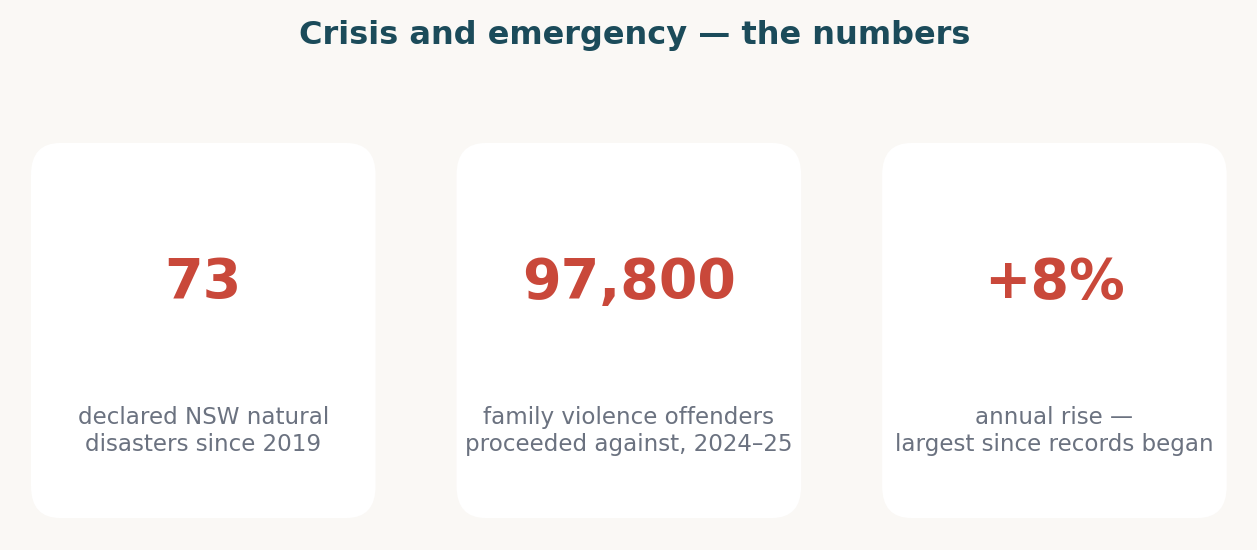
Figure 5.1 — Disaster and family violence indicators relevant to NSW ECEC services (NSW Government, 2024; ABS, 2026).
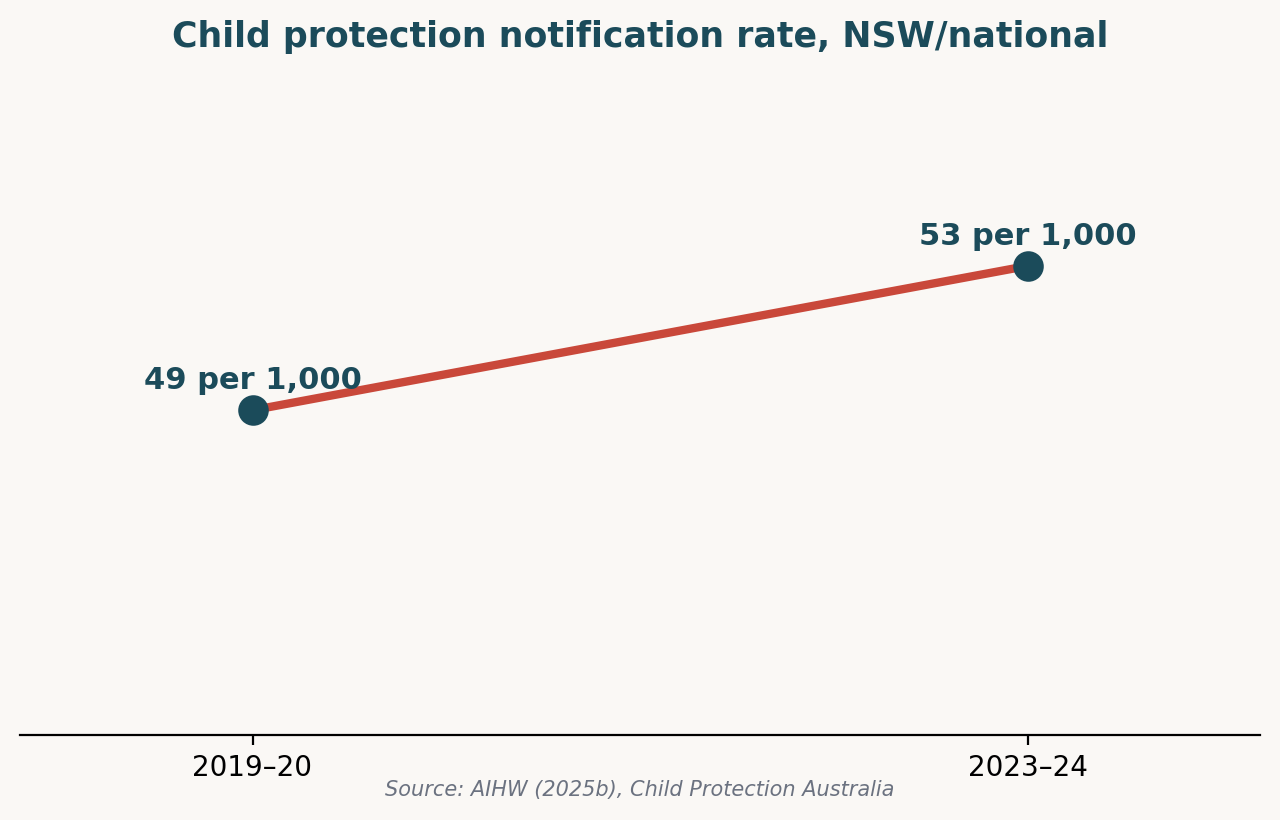
Figure 5.2 — Child protection notification rate, 2019–20 to 2023–24 (AIHW, 2025a).
Section B: Impact on Children and Families
Infants are physically more vulnerable in disasters because of their nutritional needs, and their disposition and reliance on others (Gribble et al., 2019, as cited in Australian Journal of Emergency Management, 2024), a physical vulnerability—not a psychological vulnerability—and one that must be planned for during a disaster. These statistics, based on substantiated cases and not prevalence, show that nationally the proportion of Australian adults who say they've witnessed partner violence against a parent has risen from 13 per cent in 2019-20 to 14 per cent in 2023-24 (AIHW, 2025b) and the proportion of substantiated child protection cases has risen from 49 to 53 per 1,000 children between 2019-20 and 2023-24 (AIHW, 2025a). It is also important to note that a parent that takes steps to prevent violence could actively reject certain known routines, as predictability can be a risk. The relationship between protective factors and outcomes is quite loose - many children turn out OK with regular, calm adult support.
Section C: Social Policy and Australian Responses
The NSW Government (2024, 2025) labels Recovery Programs as mainly Resilient Homes and Resilient Lands, and the NSW Reconstruction Authority coordinates the funding of disaster recovery. Recovery processes can be slow, as Legal Aid NSW (2024) points out, for individual families. The National Plan to End Violence against Women and Children 2022–2032 provides a ten-year plan for violence against women and children that is structured around three strands: prevention, early intervention, and response and recovery, as part of a list of contributing sectors that includes education and/or care settings (DSS, 2022).
Section D: Five Evidence-Based Strategies for Practice
| # | Evidence-based strategy for practice |
|---|---|
| 1 | Co-created disaster preparedness and psychological first aid. Simple emergency routines built into play, and annual staff training, increase predictability and confident response. |
| 2 | Flexible, trauma-informed enrolment and attendance policy. Pre-agreed fee relief and priority-place processes preserve the child-educator relationship, as the Eugowra model demonstrates. |
| 3 | Safety-planning-aware, confidential practice. Discreet drop-off arrangements and protected sign-in information reduce the risk of a family's routine being inadvertently disclosed. |
| 4 | Child voice and community-connected recovery pedagogy. Art or storytelling projects, modelled on the Northern Rivers peer-support storybook initiative, build agency rather than passivity. |
| 5 | Referral and mandatory reporting literacy. A rehearsed escalation pathway and current contact details for 1800RESPECT ensure timely, consistent response to disclosures. |
Section E: Community and Professional Partnerships
| Organisation | Role / referral purpose |
|---|---|
NSW Reconstruction Authority nsw.gov.au |
Coordinates disaster recovery funding and rebuilding for NSW communities, including damaged services. |
Australian Red Cross redcross.org.au |
Emergency relief and psychological first aid training for parents and educators. |
1800RESPECT 1800respect.org.au |
National 24/7 domestic, family and sexual violence counselling and referral. |
Domestic Violence NSW dvnsw.org.au |
NSW peak body linking services to local specialist family violence support. |
Emerging Minds emergingminds.com.au |
National training and the Community Trauma Toolkit for the education workforce. |
Section F: Resources for Educators and Children
| Category | Resources |
|---|---|
| Programs / Websites | NSW Reconstruction Authority Recovery Support; Community Trauma Toolkit — Resources for Educators (emergingminds.com.au); Australian Red Cross — Get Prepared/RediPlan (redcross.org.au); 1800RESPECT Resource Hub. |
| Storybooks (birth–5) | The Fire Wombat, Jackie French (2021) — bushfire shelter, based on 2019–20 fires. Flood, Jackie French (2011) — community rescue after flood, adult-mediated reading. The Invisible String, Patrice Karst (2018 ed.) — connection during separation. The Huge Bag of Worries, Virginia Ironside (2004) — sharing worry with a trusted adult. |
| Videos / Shows / Podcasts | Play School — Everyday Helpers episodes (ABC Kids); Community Trauma Toolkit video resources (Emerging Minds); Sesame Street in Communities — Coping with Difficult Experiences; Play School — SES and storm helpers segment. |
Reference List
Australian Bureau of Statistics. (2026, March 18). Family and domestic violence offenders rise by 8 per cent [Media release]. https://www.abs.gov.au/media-centre/media-releases/family-and-domestic-violence-offenders-rise-8-cent
Australian Institute of Health and Welfare. (2023). Family and domestic violence. https://www.aihw.gov.au/family-domestic-and-sexual-violence/types-of-violence/family-domestic-violence
Australian Institute of Health and Welfare. (2025a). Child protection. https://www.aihw.gov.au/family-domestic-and-sexual-violence/responses-and-outcomes/child-protection
Australian Institute of Health and Welfare. (2025b). FDSV summary. https://www.aihw.gov.au/family-domestic-and-sexual-violence/resources/fdsv-summary
Department of Social Services. (2022). National Plan to End Violence against Women and Children 2022–2032. Australian Government. https://www.dss.gov.au/national-plan-end-violence-against-women-and-children
Emerging Minds. (2019). Supporting wellbeing and resilience in children before, during and after a disaster: A handbook for educators.
Emerging Minds. (2021). For schools: Supporting student voice in disaster recovery. https://emergingminds.com.au/resources/for-schools-supporting-student-voice-in-disaster-recovery/
Gribble, K. D., Peterson, M., & Brown, D. (2019). Emergency preparedness for infant and young child feeding in emergencies (IYCF-E): An Australian Breastfeeding Association project. [As cited in Australian Journal of Emergency Management, 2024]
Howard, J., L'Estrange, L., & Brown, M. (2022). National guidelines for trauma-aware education in Australia. Frontiers in Education, 7, Article 826658. https://doi.org/10.3389/feduc.2022.826658
Legal Aid NSW. (2024). Submission No. 60: Review of the NSW Reconstruction Authority Act 2022 [Submission to the Joint Select Committee on the NSW Reconstruction Authority]. NSW Parliament.
NSW Government. (2024). Award winners helping to build community resilience to disasters and emergencies. https://www.nsw.gov.au/ministerial-releases/award-winners-helping-to-build-community-resilience-to-disasters-and-emergencies
NSW Government. (2025). Disaster Recovery Funding Arrangements (DRFA) coordination. NSW Reconstruction Authority. https://www.nsw.gov.au/departments-and-agencies/nsw-reconstruction-authority/about-us/reconstruction/disaster-recovery-funding-arrangements
Save the Children International. (2023, October 4). Bushfires and floods: Threat of multiple disasters in Australia put children's wellbeing at risk. https://www.savethechildren.net/news/bushfires-and-floods-threat-multiple-disasters-australia-put-children-s-wellbeing-risk
The Educator. (2024, July 11). Healing through stories: How one book supports kids after Northern Rivers floods. https://www.theeducatoronline.com/k12/news/healing-through-stories-how-one-book-supports-kids-after-northern-rivers-floods/285114