
This context includes two separate but super-imposed types of families, those living in poverty and those in housing stress with experiences of homelessness. Both are the biggest cost in most Australian household budgets, but can happen to one family rather than the other—although a family could be housed and not well off or could have great wages and income and still feel pushed into housing stress if their rent goes up or they lose their job.
According to the 50 per cent of median income threshold, after housing costs, 3.7 million people (or 14.2 per cent of all residents) were living below this threshold in 2022-23, and 757,000 children (or 15.6 per cent of children under the age of 15) were living below it in 2022-23 (ACOSS & UNSW Sydney, 2025). It was $464 per week less than what all families below the line experienced on average. Housing stress can broadly be described as spending more than 30 per cent of family income on rent or housing loan repayments or as living in overcrowded or unstable situations, and/or as moving frequently for young children. Difficult lives are formed and sustained by families of both classes of workers – non-employed as well as underemployed and insecure casuals.
Income influences access to ECEC. Direct costs (gap fees) and indirect costs (travel, nappies and clothing) were consistently named by parents and providers as factors which make it harder to enrol and return children to quality early learning — this is a huge equity issue as it is recognised that disadvantaged children benefit more from quality early learning on a ratio basis.
A provisional model that can be employed here is Bronfenbrenner's “bioecological model” (Bronfenbrenner & Morris, 2006), which mitigates the need to focus on family deficit by directing attention to the structures in which families operate, namely the microsystem (parental stress, routines) and the exosystem (parent's precarious work schedule/parent's decision on a housing tribunal). Social capital theory also suggests that strong relationship-building well before a material disadvantage has occurred – with a trusted relationship, in this instance with an ECEC service – to some extent reduces material disadvantage.
Section A: Understanding the Context
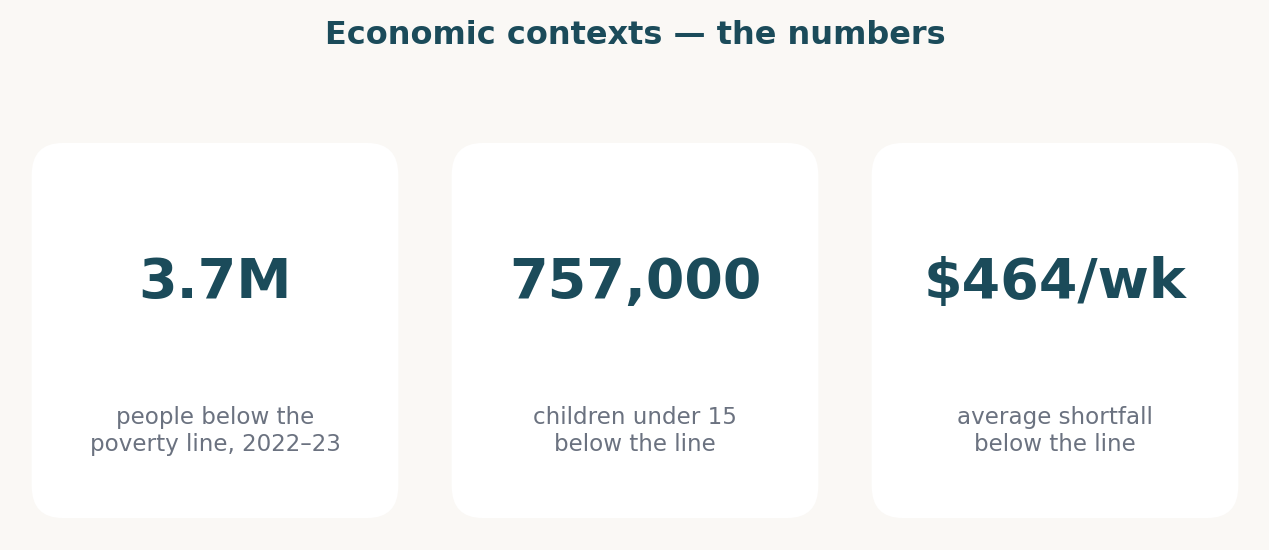
Figure 1.1 — Key economic indicators for Australian families, 2022–23 (ACOSS & UNSW Sydney, 2025).
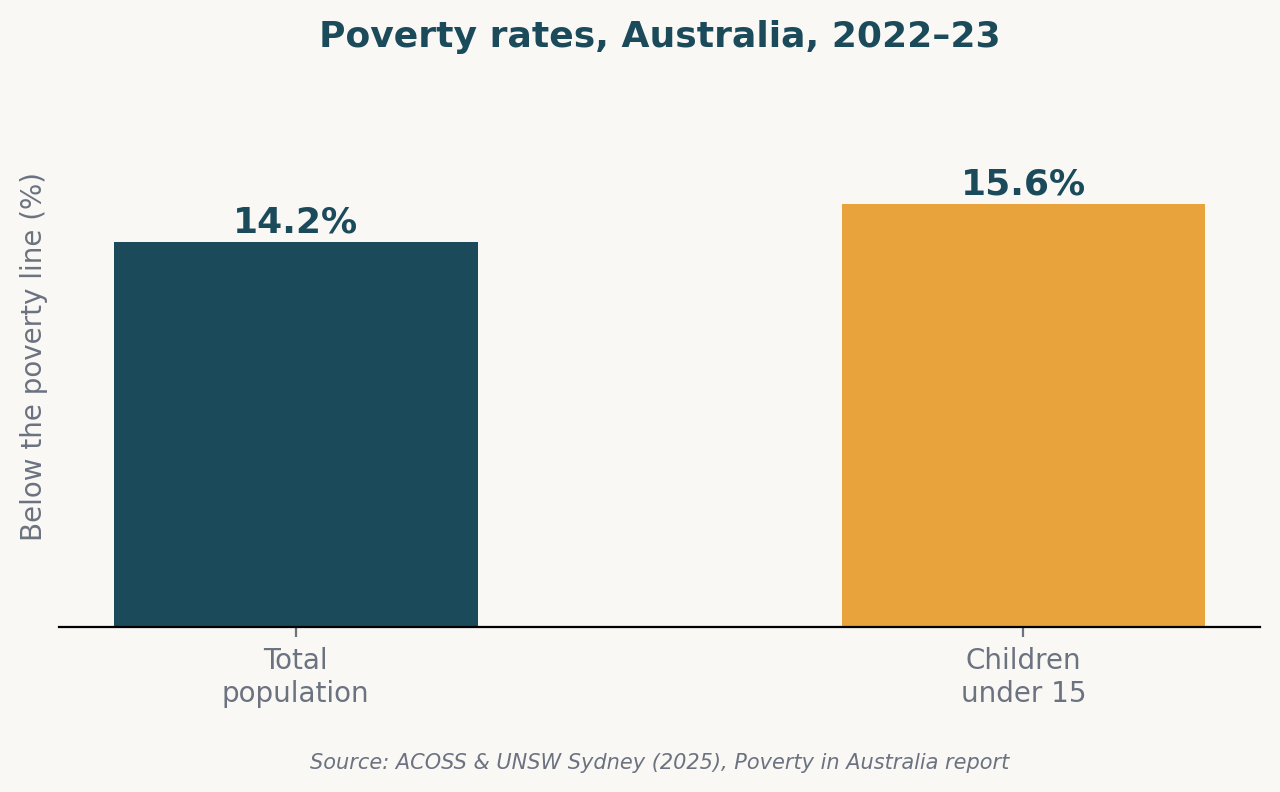
Figure 1.2 — Poverty rates for the total population compared with children under 15, 2022–23.
Section B: Impact on Children and Families
Poor outcomes linked to persistently low income: higher household stress exposure, less access to books and enriching experiences, and/or disrupted patterns of play and educator and peer group changes when experiencing housing instability. Risks do not indicate a foregone conclusion: when a parent's income is low, for example, a stable caretaking environment, consistent schedules and a family's resourcefulness are always protective factors, and teachers should not assume parenting competence based on economic status. Finances, not being able to provide extra clothes or embarrassment about financial circumstances can be interpreted as disaffection when these are actually factors of cost or shame.
Section C: Social Policy and Australian Responses
Children from low income and housing insecure families are identified as priority groups in the Early Years Strategy 2024-2034 in the Australian Government Department of Social Services (2024). In addition to gap fees, which can be an obstacle to accessing child care with eligibility, the primary tool used to incentivize child care providers for cost reduction is the Child Care Subsidy, including Additional Child Care Subsidy for temporary hardship. Start Strong for Community Preschools has an equity structure in NSW - services in areas of higher disadvantage will be funded at a higher rate and lower-income families will get a fee-relief loading (NSW Department of Education, 2023, 2026) and since 2025, another Additional Targeted Equity Loading will be used to fund inclusion (NSW Department of Education, 2025). A family will not automatically receive fee relief, so it might be necessary to communicate this to them.
Section D: Five Evidence-Based Strategies for Practice
| # | Evidence-based strategy for practice |
|---|---|
| 1 | Proactively connect families to fee relief and subsidy entitlements. A routine eligibility check at enrolment, not only when hardship is disclosed, addresses the under-recognised barrier Beatson et al. (2022) identified. |
| 2 | Reduce hidden, indirect costs of participation. Auditing excursions, dress-up days and donations for cost, and building free alternatives in by default, targets a barrier easily missed because no single item looks large alone. |
| 3 | Build strengths-based relationships before a crisis point. Warm, non-judgemental drop-off check-ins create the relational trust social capital theory identifies as needed for a family to disclose hardship early. |
| 4 | Maintain predictable routines to buffer instability at home. Keeping a child's educator, room and cubby stable during housing transitions offsets the loss of predictability elsewhere in the child's life. |
| 5 | Establish a clear referral pathway to financial and housing support. A rehearsed, warm hand-off to services such as the National Debt Helpline lowers the barrier to families seeking help early. |
Section E: Community and Professional Partnerships
| Organisation | Role / referral purpose |
|---|---|
The Smith Family — Learning for Life thesmithfamily.com.au |
Long-term mentoring and sponsorship keeping children from low-income families engaged in education; referral point at enrolment. |
Anglicare Australia (NSW) anglicare.org.au |
Emergency relief, financial counselling and housing assistance; a first point of referral for acute crisis. |
Good Shepherd — No Interest Loan Scheme goodshep.org.au |
Small no-interest loans for essential items such as whitegoods or car seats. |
Mission Australia missionaustralia.com.au |
Homelessness and housing services across NSW; can support enrolment continuity during a housing transition. |
National Debt Helpline ndh.org.au |
Free, confidential financial counselling; a low-barrier first call for families in fee arrears. |
Section F: Resources for Educators and Children
| Category | Resources |
|---|---|
| Programs / Websites | The Smith Family — Learning for Life; Raising Children Network — Money, Work and Family (raisingchildren.net.au); Good Shepherd NILS directory (goodshep.org.au/nils); Sesame Street in Communities — Economic Hardship & Homelessness toolkit. |
| Storybooks (birth–5) | A Chair for My Mother, Vera B. Williams (1982) — saving and community support after loss. Those Shoes, Maribeth Boelts (2007) — wanting versus needing. Fly Away Home, Eve Bunting (1991) — family homelessness, preview before use. The Teddy Bear, David McPhail (2002) — kindness and dignity, wordless. |
| Videos / Shows / Podcasts | “Home Is” (Sesame Street in Communities) — home as belonging, not an address. “We Got This” (Sesame Street in Communities) — coping with housing instability. Bluey (ABC Kids) — everyday family resilience. Play School (ABC Kids) — family difference explored gently. |
Reference List
Australian Council of Social Service, & UNSW Sydney. (2025). Poverty in Australia 2025: Overview. Poverty and Inequality Partnership. https://povertyandinequality.acoss.org.au/poverty_in_australia_2025_overview/
Australian Government Department of Social Services. (2024). Early Years Strategy 2024–2034. https://www.dss.gov.au/families-and-children-programs-services-early-years-strategy
Beatson, R., Molloy, C., Fehlberg, Z., Weston, S., & Goldfeld, S. (2022). Early childhood education participation: A mixed-methods study of parent and provider perceived barriers and facilitators. Journal of Child and Family Studies, 31, 2929–2946. https://doi.org/10.1007/s10826-022-02274-5
Bronfenbrenner, U., & Morris, P. A. (2006). The bioecological model of human development. In W. Damon & R. M. Lerner (Eds.), Handbook of child psychology: Vol. 1. Theoretical models of human development (6th ed., pp. 793–828). Wiley.
NSW Department of Education. (2023). 2023 Start Strong for Community Preschools program guidelines. https://education.nsw.gov.au/early-childhood-education
NSW Department of Education. (2025). Additional Targeted Equity Loading funding. https://education.nsw.gov.au/early-childhood-education/operating-an-early-childhood-education-service/grants-and-funded-programs/additional-targeted-equity-loading-funding
NSW Department of Education. (2026). Start Strong for families. https://education.nsw.gov.au/early-childhood-education/operating-an-early-childhood-education-service/grants-and-funded-programs/start-strong-funding/start-strong-for-families