
Section A: Understanding the Context
This context looks at two populations of families: Aboriginal and Torres Strait Islander families, and refugee and newly arrived families, with the shared understanding that these populations are not homogenous or interchangeable, or that a refugee-family would necessarily qualify as an Aboriginal and Torres Strait Islander family; it is important to acknowledge that a refugee family is not automatically an Aboriginal and Torres Strait Islander family; there are more than 250 distinct languages spoken by Aboriginal and Torres Strait Islander families; refugee and newly available families come from different countries and different circumstances.
Aboriginal and Torres Strait Islander families carry a legacy of a past connectedness to culture, community and Country, as well as on-going impacts of historical separation policies, leading to matters of trust in the mainstream institutions for some families. The Aboriginal Cultural Safety Framework (2022) developed by SNAICC, defines cultural safety as a service responsibility and not a family adjustment: enrolment alone isn't enough, quality and cultural safety must be included in the equation as well.
Families in both refugee and newly arrived status continue to bear great structural and resilience pressures. The number of children on the H umanitarian Program entering NSW annually has been directly impacted each year by the total visa numbers in the offshore H umanitarian Program which in 2020-21 had reached a 45-year low of 5,749 visas before rising to 15,875 by 2022-23 (Department of Home Affairs, 2022, 2023a). Researchers stress the importance of resilience and resourcefulness of children, rather than the passive. Consider settlement as process and ECEC as one of the first Australian institutions a newly arrived family likely will regularly engage with.
Cultural safety is not the same as cultural awareness and is a responsibility issue of the service or health worker to additionally engage in a reflexive practice (AERO, n.d.). It is important to consider the national frameworks because they can be seen as part of Bronfenbrenner's macrosystem, which will impact what is normalised in daily practice, if Aboriginal and Torres Strait Islander perspectives are included in curriculum and funding structures (Australian Government Department of Education, 2022). Intersectionality acknowledges that the settlement experience of refugee families are complex and determined by family status, language use, age, and in some cases gender, as no one factor can explain a family's situation.
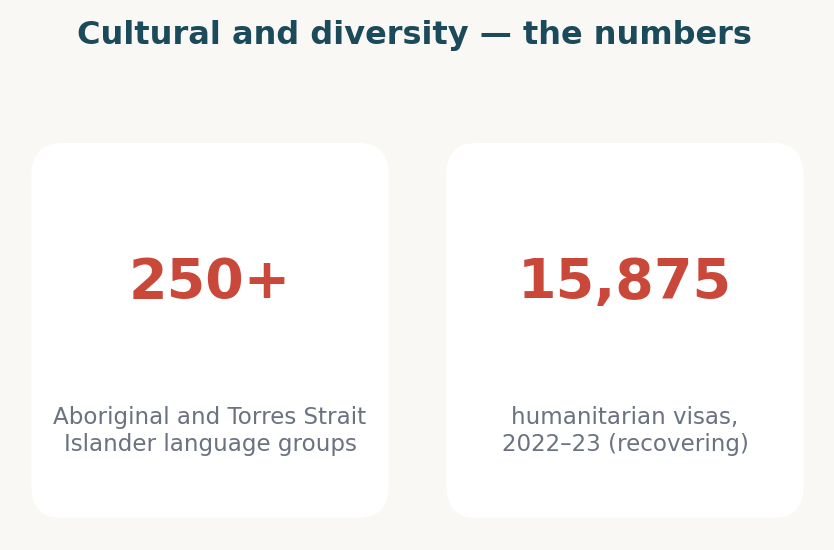
Figure 3.1 — Diversity and settlement indicators relevant to NSW ECEC services.
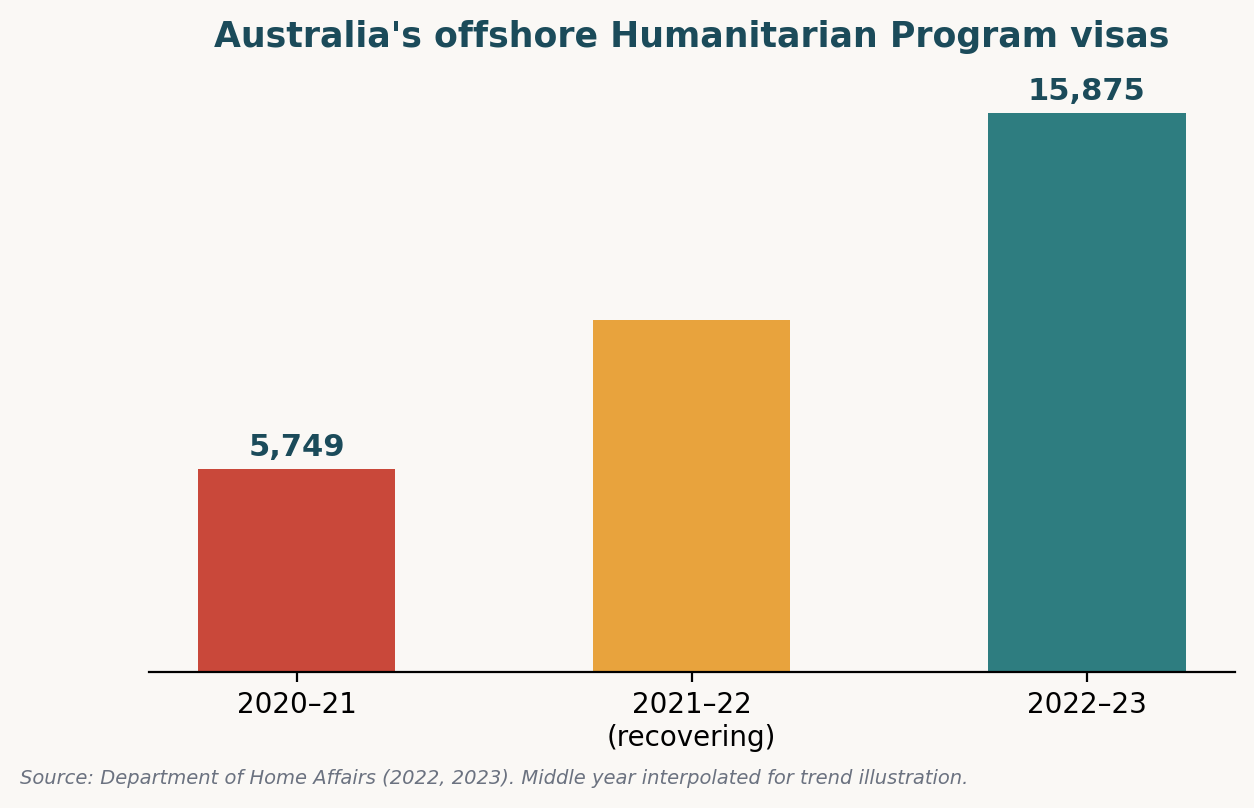
Figure 3.2 — Australia's offshore Humanitarian Program visa numbers, 2020–21 to 2022–23 (Department of Home Affairs, 2022, 2023a).
Section B: Impact on Children and Families
It is not who is in the service but how the service supports children, and culturally unsafe services may also exacerbate and diminish access barriers for Aboriginal and Torres Strait Islander children. (Australian Government Department of Education, 2023) Transition to a new language and routines may impact communication and emotional security at the start of transition for refugee and newly arrived children, especially when they have experience of disruption, language can mediate feeling connected (Naidoo, 2019). Protective factors surface in both contexts – cultural identity and community connection for Aboriginal children; and whole family strengths-based settlement programs for refugee-background children.
Section C: Social Policy and Australian Responses
Educators must incorporate Aboriginal and Torres Strait Islander perspectives for all children in the EYLF V2.0 (Australian Government Department of Education, 2022), which is then clarified when applied to ECEC by SNAICC's framework, and there is a targeted subsidy for Aboriginal three-year-olds in NSW Start Strong. Commonwealth settlement support for refugee families is provided through the Humanitarian Settlement Program and SETS, provided by contracted agencies (Department of Home Affairs, 2024), but there is a ongoing issue regarding the access guarantee from the Federal Government and changing delivery in the states (Law Council of Australia, 2024). As far as the current national EC outcome area goes, there is currently no similar one that addresses the early education and care of refugee children in particular.
Section D: Five Evidence-Based Strategies for Practice
| # | Evidence-based strategy for practice |
|---|---|
| 1 | Embedding Acknowledgement of Country and ongoing local relationships. A sustained relationship with the local Aboriginal community and Aboriginal Community Controlled Organisation, beyond a scripted acknowledgement. |
| 2 | Visible multilingualism. Displaying and using home languages in signage and greetings treats a refugee-background child's first language as an asset. |
| 3 | Bicultural and bilingual support. Partnering with bicultural workers or interpreters for enrolment avoids relying on a child to informally translate for a parent. |
| 4 | Trauma-informed welcome practices. Predictable routines and consistent key educators for newly arrived children, consistent with STARTTS-taught trauma-informed principles. |
| 5 | Community co-design of enrolment and orientation. Involving Elders and settlement caseworkers in shaping how a service welcomes new families. |
Section E: Community and Professional Partnerships
| Organisation | Role / referral purpose |
|---|---|
SNAICC — National Voice for our Children snaicc.org.au |
National peak body providing the Cultural Safety Framework and sector guidance. |
AbSec absec.org.au |
NSW peak body for Aboriginal children and families; referral and advisory partner. |
Settlement Services International ssi.org.au |
NSW settlement agency supporting refugee and humanitarian entrants. |
STARTTS startts.org.au |
Specialist trauma support and training for services working with refugee-background families. |
Refugee Council of Australia refugeecouncil.org.au |
National policy advocacy and sector information. |
Section F: Resources for Educators and Children
| Category | Resources |
|---|---|
| Programs / Websites | SNAICC resources hub; HIPPY Australia (hippyaustralia.bsl.org.au); Narragunnawali reconciliation program (reconciliation.org.au/narragunnawali); STARTTS professional resources (startts.org.au). |
| Storybooks (birth–5) | Big Rain Coming, Katrina Germein & Bronwyn Bancroft (1999) — remote Aboriginal community life. Welcome to Country, Aunty Joy Murphy & Lisa Kennedy — introduces Acknowledgement of Country. My Two Blankets, Irena Kobald & Freya Blackwood (2014) — a refugee girl learning language and belonging. Mirror, Jeannie Baker (2010) — wordless cross-cultural comparison. |
| Videos / Shows / Podcasts | Little J & Big Cuz (NITV/ABC) — young Aboriginal and Torres Strait Islander characters. Play School — Acknowledgement of Country segments (ABC iview). Waabiny Time (NITV) — presented substantially in Noongar language. Move It Mob Style (NITV) — Aboriginal-led movement program; verify current availability. |
Reference List
Australian Education Research Organisation. (n.d.). Cultural safety. https://www.edresearch.edu.au/guides-resources/practice-guides/cultural-safety
Australian Government Department of Education. (2022). Belonging, being & becoming: The Early Years Learning Framework for Australia (V2.0). Australian Government.
Australian Government Department of Education. (2023). Early childhood education and care and Aboriginal and Torres Strait Islander children. Australian Government.
Department of Home Affairs. (2022). Australia's offshore Humanitarian Program: 2021–22. Australian Government. https://www.homeaffairs.gov.au/research-and-stats/files/australia-offshore-humanitarian-program-2021-22.pdf
Department of Home Affairs. (2023a). Australia's migration trends 2022–23. Australian Government. https://www.homeaffairs.gov.au/research-and-stats/files/migration-trends-2022-23.pdf
Department of Home Affairs. (2023b). Evaluation of the Settlement Engagement and Transition Support (SETS) program. Australian Government. https://immi.homeaffairs.gov.au/settlement-services-subsite/files/evaluation-sets-grants-program-report.pdf
Department of Home Affairs. (2024). Settlement Engagement and Transition Support (SETS) program: Overview. Australian Government. https://immi.homeaffairs.gov.au/settling-in-australia/sets-program/overview
Law Council of Australia. (2024). Next steps to improve Australia's settlement and integration of refugees [Submission]. https://lawcouncil.au/resources/submissions/next-steps-to-improve-australia-s-settlement-and-integration-of-refugees
Naidoo, L. (2019). Schooling, refugees and belonging in Australia. Springer.
Productivity Commission. (2024). Review of the National Agreement on Closing the Gap. Australian Government. https://www.pc.gov.au/closing-the-gap-review
Productivity Commission. (2026). A path to universal early childhood education and care [Final report]. Australian Government. https://www.pc.gov.au/inquiries/completed/early-childhood/report
Refugee Council of Australia. (2022). Submission on Australia's Humanitarian Program 2022–23. https://www.refugeecouncil.org.au/wp-content/uploads/2022/08/RCOA-2022-2023-Humanitarian-Program-Submission.pdf
SNAICC — National Voice for our Children. (2022). Aboriginal Cultural Safety Framework for Early Childhood Education: Phase 1 final report. https://education.nsw.gov.au/content/dam/main-education/early-childhood-education/operating-an-early-childhood-education-service/current-service-providers/Aboriginal_Cultural_Safety_Framework_for_Early_Childhood_Education_Phase_1_Final_Report.pdf