
Section A: Understanding the Context
The context is explored in the context of two types of families that have been determined by different mechanisms; single-parent families and families living in geographically isolated areas of the rural and remote areas of NSW. Single-parent families vary greatly in their composition, with single parenting being a result either of separation or bereavement, or of choice. For children in infancy (0–2 years) and in the preschool (3–5 years) data from the Longitudinal Study of Australian Children indicated that a higher proportion of children with an employed single parent were attending ECEC compared with children in dual-employed couple families (65% versus 49% of 0–2 years and 67% versus 48% of 3–5 years) (Australian Institute of Family Studies, 2017). It may imply that the parents are not involved, which isn't the case if they are in the workforce — ECEC is an active workforce-participation approach.
Geographic isolation is not related to family structure. Over 30% of Australians are in “childcare deserts” (ced) -- areas where there are a higher number of children for each available child care place in that location -- and the majority of these are in regional and remote areas (Hurley, 2022). In-home care, the primary available option, is not available to many remote families requiring care, due to the need for an educator to work multiple families, and a 21,000-educator shortfall is concentrated in remote areas, which are already underserved (ICPA, 2023; Jobs and Skills Australia, 2024).
The mesosystem and exosystem are applicable here (Guy-Evans, 2024): parent's job status and the managers of services, such as in a region, neither directly meet the child, nor involve them directly, but significantly influence attendance. Social capital theory also provides the notion of bridging social capital: which structurally more difficult to establish when the service is an hour or more away. The theories locate the barrier on the surrounding system or rather than in the motivation of parents.
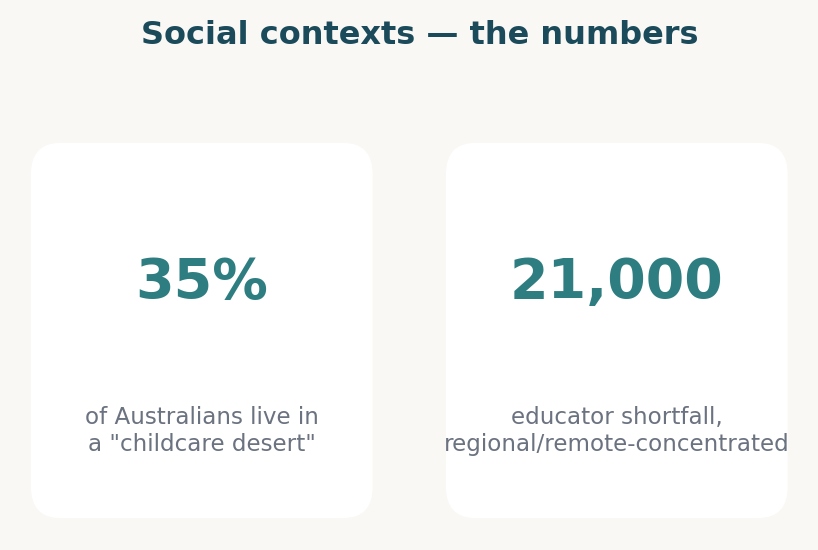
Figure 2.1 — Access barriers facing geographically isolated families (Hurley, 2022; Jobs and Skills Australia, 2024).
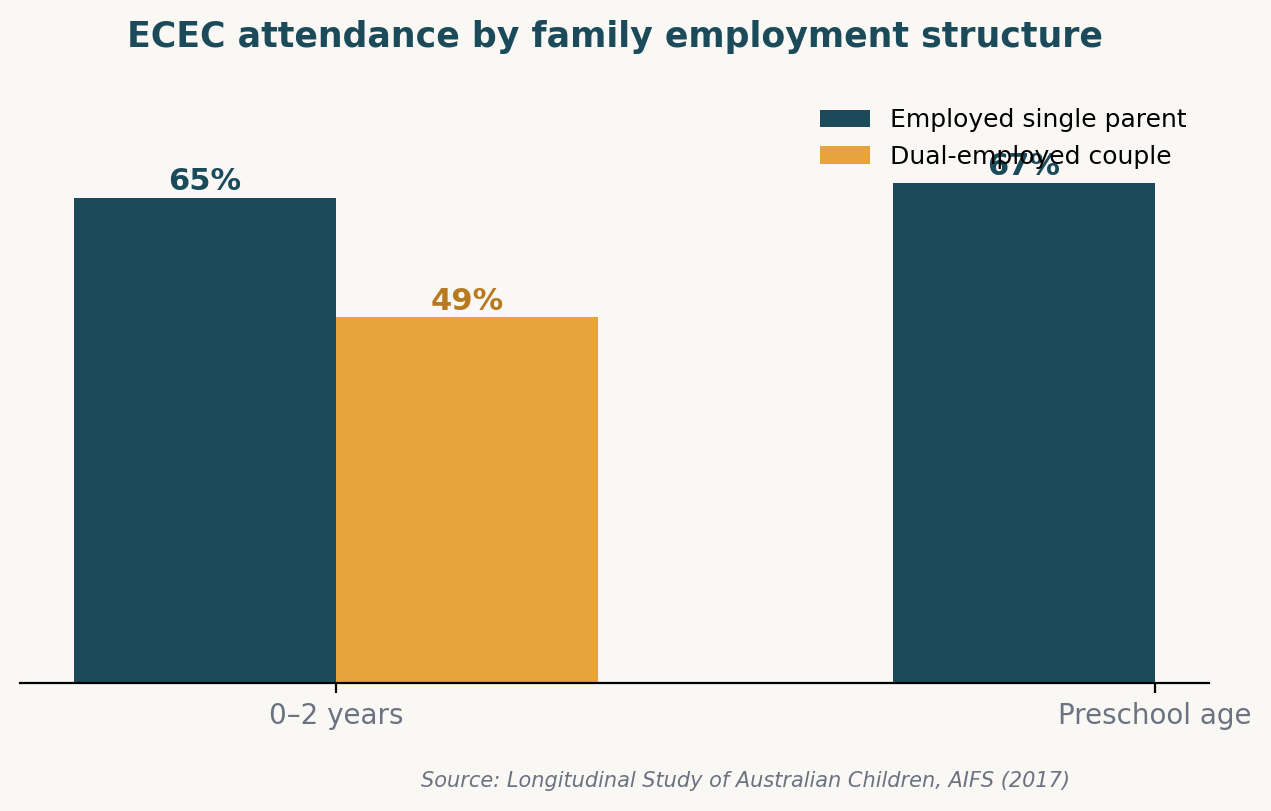
Figure 2.2 — ECEC attendance by family employment structure, infancy and preschool age (AIFS, 2017).
Section B: Impact on Children and Families
The quality of relationships and material security has the greater impact on outcomes for single-parent families than does parenthood more broadly – and represents the type of relationship and caregivers that is known to be a protective factor of outcomes (AIFS, 2025). Whereas for isolated households, missing quality ECEC before school signifies unlearnt skills, related to school readiness (AIHW, 2025) and can go so far as leaving a parent feeling a sense of isolation in both their two-parent home or as are the sole caregivers of children outside of a home setting. Similar support exists to these hazards: single-parent families rely on kin support, flexible work arrangements are often used, and rural communities may have high levels of bonding social capital, which can compensate for informal resources.
Section C: Social Policy and Australian Responses
While this is the main participation lever for both family types, NSW's Start Strong initiative pays for early access early intervention for low income and Aboriginal 3-year-olds (Productivity Commission, 2026). The Commonwealth's primary program for use with isolated families is the In-Home Care program, which offers multi-family services to limit access to the families with the greatest distance (ICPA, 2023). Current evidence favours direct government provision of assistance or government partnerships (Australian Education Research Organisation, 2025) over exclusively demand side subsidy because if there is no provision to subsidise then a subsidy cannot assist.
Section D: Five Evidence-Based Strategies for Practice
| # | Evidence-based strategy for practice |
|---|---|
| 1 | Flexible enrolment and communication. Evening or asynchronous orientation, and forms that do not assume two co-resident parents, avoid structurally disadvantaging single-parent families from the outset. |
| 2 | Strengths-based intake conversations. Asking “who else is involved in this child's life?” rather than defaulting to deficit-coded paperwork supports engagement without assumption. |
| 3 | Partnering with telehealth and outreach providers. Embedding services such as Royal Far West's telehealth program ensures distance does not cut children off from specialist support. |
| 4 | Community-connection programming. Regular playgroup or “community day” sessions in isolated areas build bridging social capital formal infrastructure alone cannot supply. |
| 5 | Predictable transition routines. Consistent visual routines and transition objects support children moving between two households, aiding co-regulation regardless of custody arrangements. |
Section E: Community and Professional Partnerships
| Organisation | Role / referral purpose |
|---|---|
Single Mother Families Australia smfa.com.au |
National advocacy, information and referral for single mothers. |
Services Australia servicesaustralia.gov.au |
Administers Parenting Payment and Child Care Subsidy; first point of referral for income support. |
Relationships Australia NSW relationshipsnsw.org.au |
Counselling and family dispute resolution relevant to separated and single-parent families. |
Royal Far West royalfarwest.org.au |
Telehealth and in-community allied health for rural and remote NSW children. |
Isolated Children's Parents' Association icpa.com.au |
Advocacy body for geographically isolated families and current access barriers. |
Section F: Resources for Educators and Children
| Category | Resources |
|---|---|
| Programs / Websites | Raising Children Network (raisingchildren.net.au); HIPPY Australia home-based learning program (hippyaustralia.bsl.org.au); Royal Far West Schools & Early Years Services; Start Strong NSW subsidy information (education.nsw.gov.au). |
| Storybooks (birth–5) | Are We There Yet?, Alison Lester (2004) — normalises distance and travel. Love Makes a Family, Sophie Beer (2018) — illustrates diverse family structures. Family Forest, Kim Kane & Lucy Masciullo — explains blended and step-family structures. The Patchwork Bike, Maxine Beneba Clarke (2016) — mother-headed family and rural resourcefulness. |
| Videos / Shows / Podcasts | Play School (ABC iview) — diverse family structures in everyday routines. Bluey (ABC Kids) — everyday family life and problem-solving. ABC Education — School of the Air segments — normalises remote schooling and family life. Raising Children Network video library — separation and single-parent adjustment content for professional development. |
Reference List
Australian Education Research Organisation. (2025, February). Delivery approaches in regional and remote thin markets: A review of the evidence for improving access to quality children's education and care services. https://www.edresearch.edu.au/research/research-reports/delivery-approaches-regional-and-remote-thin-markets
Australian Institute of Family Studies. (2017). Longitudinal Study of Australian Children annual statistical report 2017. AIFS. https://growingupinaustralia.gov.au/research-findings/annual-statistical-report-2017
Australian Institute of Family Studies. (2025). Rapid scoping review of protective factors for parent and child wellbeing. AIFS. https://aifs.gov.au/all-research/research-reports/rapid-scoping-review-protective-factors-parent-and-child-wellbeing
Australian Institute of Health and Welfare. (2025). Education and skills: From early childhood to tertiary education. AIHW, Australian Government. https://www.aihw.gov.au/reports/australias-welfare/early-childhood-to-tertiary-education
Guy-Evans, O. (2024). Bronfenbrenner's ecological systems theory. Simply Psychology. https://www.simplypsychology.org/bronfenbrenner.html
Hurley, P. (2022). Deserts and oases: How accessible is childcare in Australia? Mitchell Institute, Victoria University. https://www.vu.edu.au/mitchell-institute/early-learning/childcare-deserts-oases-how-accessible-is-childcare-in-australia
Isolated Children's Parents' Association of Australia. (2023). Submission on early childhood education and care access for geographically isolated families. ICPA Australia. https://icpa.com.au
Isolated Children's Parents' Association of Australia. (2024). Submission on the ECEC workforce and wage reform. ICPA Australia. https://icpa.com.au
Jobs and Skills Australia. (2024). The future of the early childhood education profession: Summary report. Australian Government. https://www.jobsandskills.gov.au/sites/default/files/2024-09/the_future_of_the_early_childhood_education_profession_-_summary_report.pdf
Productivity Commission. (2026). A path to universal early childhood education and care [Final report]. Australian Government. https://www.pc.gov.au/inquiries/completed/early-childhood/report