
Section A: Understanding the Context
Focus buildings on wellbeing within the EYLF V2.0 refers one of five learning outcomes; however, the nature of what wellbeing looks like in practice varies across the broad range of circumstances and challenges that families face. The mental health issues and grief/bereavement faced by parents are not uncommon but are shared experiences — approximately 1 in 5 Australian children has a parent with a mental illness (Monash University, n.d.) and around 1 in 20 Australian children lose one of their parents before they are 18 years old (National Centre for Childhood Grief, n.d.). They are greatly differing in severity and visibility, and will not be assumed with any single course by educators.
There is no evidence that most parents with mental illness are incapable of parenting, especially if they are supported; problems are likely to occur if they are not supported to cope with the stress and stigma involved in their mental illness (Monash University, n.d.). Grief differs from diagnosis, it is a natural response to loss and children under the age of five will not have the concept of permanency so they may ask when a person is coming back many times or they may show grief through play and behaviour as well as words (NCCG, n.d.). Both are of importance for educators as the ECEC service is one of the only consistent family disruptions may be during their time here.
The mesosystem (Family/service SC) can amplify or dampen effects, however the theory does not entail specifying how things change. Based on attachment theory, the consistent, attuned educator can serve as another secure base in times of acute parental distress with the caveat of limited evidence from a Western context. Both situations can be understood within a resilience and protective-factors framework (AIFS, 2025), which provides a strengths-based perspective on both situations, but without being supported by strong structural structures, a resilience narrative will shift the “blame” to the family.
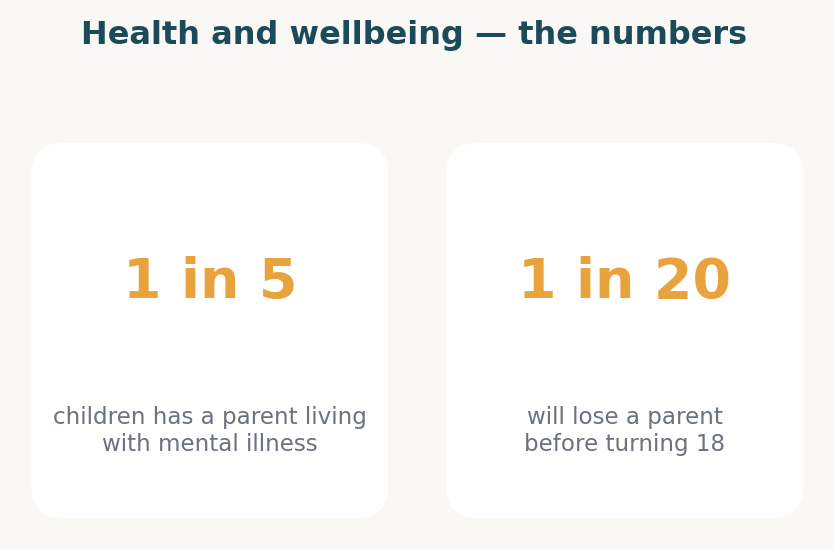
Figure 4.1 — Prevalence of parental mental illness and childhood bereavement (Monash University, n.d.; NCCG, n.d.).
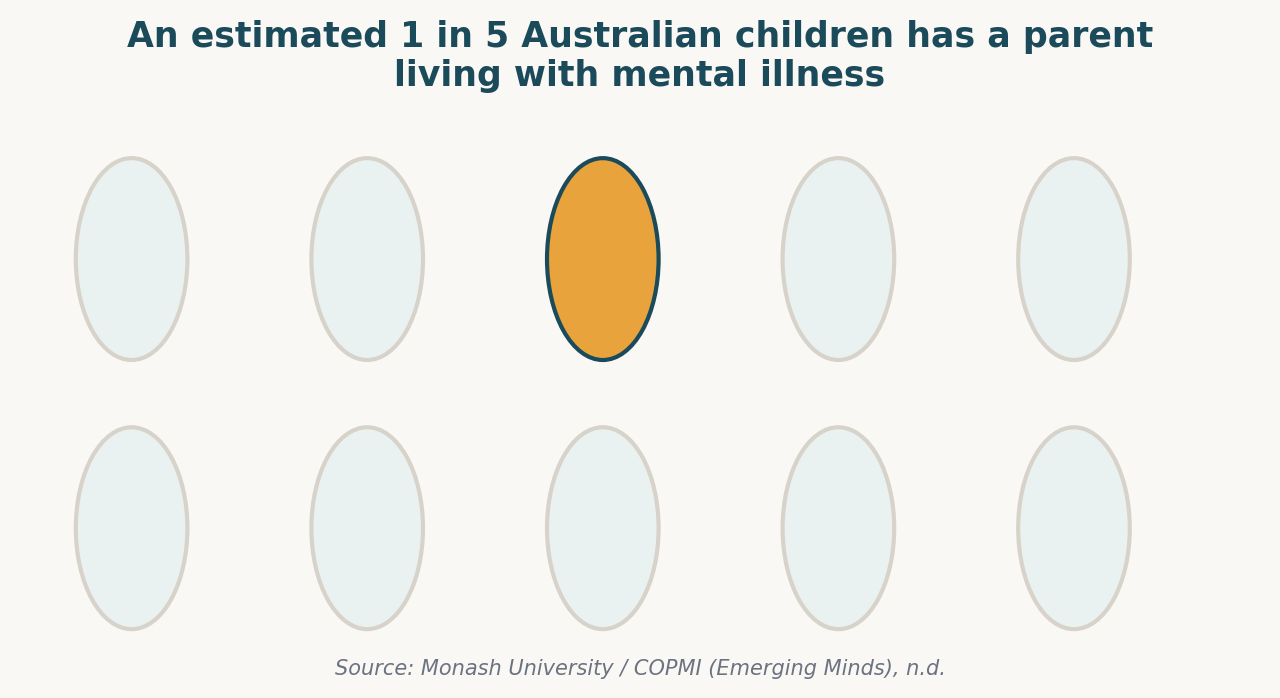
Figure 4.2 — An estimated 1 in 5 Australian children has a parent living with mental illness.
Section B: Impact on Children and Families
While there is evidence maternal depressive symptoms are predictive of internalising problems in children, links to such problems are stronger for those who are more depressed; good mental health among mothers does lessen associations with children's depressive symptoms – there are protective factors who buck the trend of worse outcomes (Ahun et al., 2018; Clayborne et al., 2023). While grief responses are common, they are often manifest in adolescent ways of regression, separation anxiety, and/or somatic symptoms, in short bursts, not as adult length processing (NCCG, n.d.). For families, stigma is an important obstacle to disclosure, a logical response and not a sign of poor parenting.
Section C: Social Policy and Australian Responses
The Early Years Strategy 2024–2034 takes a strengths-based approach (Australian Government Department of Social Services, 2024), also making a place of responsibility for policies for prevention of further harm downstream where those policies come from and beyond the provision of emergency care. First published in 2021, the National Children's Mental Health and Wellbeing Strategy (National Mental Health Commission, 2021) was a first-of-its-kind strategy to recognize and validate the tens of thousands of non-clinical, relationship-based approaches, provided through the community's most intimate settings: infant mental health. Families can be referred directly to Karitane and Tresillian for early parenting focused services in NSW.
Section D: Five Evidence-Based Strategies for Practice
| # | Evidence-based strategy for practice |
|---|---|
| 1 | Consistent key-person pedagogy. A stable primary educator for daily transitions gives a predictable attachment figure during reduced availability at home. |
| 2 | Everyday emotional literacy through play. Feelings charts and picture books build the vocabulary for internal states that supports self-regulation. |
| 3 | Strengths-based, stigma-free family communication. Private, non-diagnostic conversation (“how are things at home?”) sustains trust and continued participation. |
| 4 | Grief-responsive practice and continuity rituals. Flexible comfort-object policies and optional memory activities let a child process loss at their own pace. |
| 5 | Referral literacy and warm hand-off pathways. Offering to make a first call to a service such as PANDA reduces the emotional barrier to help-seeking. |
Section E: Community and Professional Partnerships
| Organisation | Role / referral purpose |
|---|---|
COPMI (Emerging Minds) copmi.net.au |
National resources for children of parents with mental illness, including educator material. |
Karitane karitane.com.au |
NSW early parenting support with self-referral Careline. |
Tresillian tresillian.org.au |
NSW-wide early parenting services and 24-hour parent helpline. |
PANDA panda.org.au |
National perinatal anxiety and depression helpline for parents. |
National Centre for Childhood Grief childhoodgrief.org.au |
Free bereavement counselling for children aged three to eighteen. |
Section F: Resources for Educators and Children
| Category | Resources |
|---|---|
| Programs / Websites | Be You (Beyond Blue, ECA, headspace) — beyou.edu.au; COPMI Educator Resources (copmi.net.au); Community Trauma Toolkit — Educator Resources (emergingminds.com.au); NCCG Resources for Schools and Services (childhoodgrief.org.au). |
| Storybooks (birth–5) | In My Heart: A Book of Feelings, Jo Witek (2014) — naming everyday feelings. The Rabbit Listened, Cori Doerrfeld (2018) — patient, non-directive support. Grandad's Island, Benji Davies (2015) — gentle, metaphorical treatment of death. Ruby's Worry, Tom Percival (2019) — sharing worries with a trusted adult. |
| Videos / Shows / Podcasts | Play School feelings-themed episodes (ABC Kids); Sesame Street in Communities — Emotional Wellbeing series; Sesame Street: When Families Grieve — use only with individual bereaved children with parental consent; Bluey — everyday family-life episodes modelling parental repair. |
Reference List
Ahun, M. N., Consoli, A., Pingault, J. B., Falissard, B., Genolini, C., Ionescu, J., Côté, S. M., & Tremblay, R. E. (2018). Maternal depression symptoms and internalising problems in the offspring: The role of maternal and family factors. European Child & Adolescent Psychiatry, 27(7), 921–932.
Australian Government Department of Education. (2022). Belonging, being & becoming: The Early Years Learning Framework for Australia (V2.0). Australian Government.
Australian Institute of Family Studies. (2025). Rapid scoping review of protective factors for parent and child wellbeing. AIFS. https://aifs.gov.au/all-research/research-reports/rapid-scoping-review-protective-factors-parent-and-child-wellbeing
Clayborne, Z. M., Nilsen, W., Torvik, F. A., Gustavson, K., Bekkhus, M., Gilman, S. E., et al. (2023). Positive maternal mental health attenuates the associations between prenatal stress and children's internalizing and externalizing symptoms. European Child & Adolescent Psychiatry, 32(9), 1781–1794.
De Raeymaecker, K., & Dhar, M. (2022). The influence of parents on emotion regulation in middle childhood: A systematic review. Children, 9, 1200.
Australian Government Department of Social Services. (2024). Early Years Strategy 2024–2034. https://www.dss.gov.au/families-and-children-programs-services-early-years-strategy
Howard, J., L'Estrange, L., & Brown, M. (2022). National guidelines for trauma-aware education in Australia. Frontiers in Education, 7, Article 826658. https://doi.org/10.3389/feduc.2022.826658
Monash University. (n.d.). How early childhood educators can support children who have a parent with a diagnosed mental illness. Monash Education. https://www.monash.edu/education/teachspace/articles/how-early-childhood-educators-can-support-children-who-have-a-parent-with-a-diagnosed-mental-illness
National Centre for Childhood Grief. (n.d.). Home. https://childhoodgrief.org.au/
National Mental Health Commission. (2021). National Children's Mental Health and Wellbeing Strategy. Australian Government.